
Last week, someone at an event challenged me to explain what a ‘better’ question is. What makes it better? And why do I think we ask so many wrong ones? It was a great provocation.
So now each week I am adding Better Questions to this Substack, alongside my usual One Question a Week. Joining the dots between what I see happening in the world and asking what I think is a better question. This is my first.
On Monday the 20th of July, Andy Burnham became Prime Minister, but much of the media attention chose to focus on the women he is married to, Marie-France van Heel. Within hours, former BBC radio DJ Liz Kershaw commented on her dress and her body:
“Apparently this dress is by Victoria Beckham. Bit nasty of her to let Mrs Burnham pay 900 quid for something in Crimplene that doesn’t fit her. Sisterhood eh?”
When a man becomes publicly successful in this country, we choose to tear down the woman who is associated with him and is quite often, if not always, instrumental to their success. When a woman becomes publicly successful in her own right, we also choose to tear her down if it doesn’t meet our definition of success. A two-for-the-price-of-one was seemingly too good an opportunity for Kershaw.
Two days later, on Wednesday the 22nd July, my dear friend and writer Sarada Peri wrote an essay in her Substack Thinking About a Thing on a New York Times podcast conversation between Ross Douthat, a Catholic conservative commentator and longtime New York Times columnist, and Louise Perry, a British post-liberal feminist whose book argues the sexual revolution was, on balance, bad for women. The conversation centred on what is driving the political, social, sexual and economic alienation between men and women. Perry’s answer is that it is the sexual revolution itself: that by normalising casual sex, we created a culture that benefits men at the expense of women, because men want casual sex more than women do and women bear more of its consequences.
At the end of the week, the UK Football Policing Unit released its figures from the 2026 World Cup, stating that 384 domestic violence incidents were reported during the tournament, 93% of them around England matches.
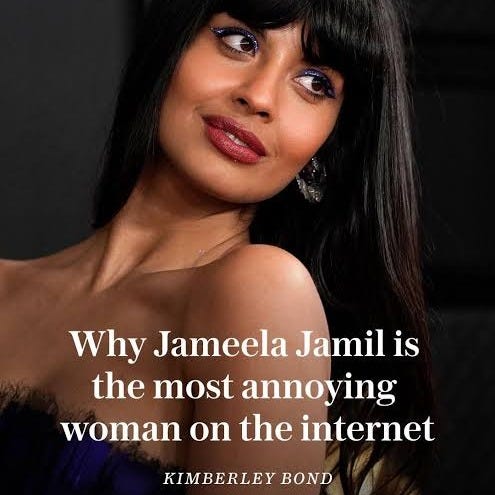
And then, the cherry on the cake, the Telegraph published an article calling presenter Jameela Jamil the most annoying woman on the internet, following an episode of a podcast in which she talked about the crimes of British colonialism, referencing her own family’s experience under the British Raj. A red rag to the right-wing, who immediately interpreted it as Jameela calling all British people cruel and demanding that she have her passport revoked.
These four examples were within a seven-day period, but I have no doubt there were many more examples of how women are understood, silenced or abused in that same period, and as always, these particular dots revert to the same thing: the patriarchy is not just a structure; it is a system maintained by money. A commercial product that thrives on insecurity, ego, and the status quo.
I am a firm believer that if you have a desire to tear someone down, especially publicly, you are, ironically, skywriting, “I don’t like myself very much.” Insecurity is a T-shirt many people don’t realise they are wearing, despite how loud it is. And it has never been louder, because it feeds on women’s dependency, and that is changing.
Since time began, women have been orbiting men, born out of a system in which our existence economically, emotionally, culturally and politically depended on a man, and the commercial architecture of the world was built around that dependency.
Today, women in the Western world have shifted from needing a man to perhaps wanting one, and wanting is an entirely different relationship; for the first time, married adults make up less than half the adult population in the UK, 49.5%, down from 51.5% a decade ago.
The financial and practical independence women have built has also created an emotional independence. Women have moved into the centre; we do not need to orbit or be orbited by anyone, and we are extending an invitation to men to be chosen. To be with a woman who does not require them to be the gravitational centre of anything, which means they have to be comfortable in who they are without that role, and this shift has implications far beyond romantic relationships.
For so long, the impetus has been to create an equitable world for women; asking how we create a safer world for women, how we create economic, political or employment opportunities for women. That a more equitable world is a moral position we should adopt for women; I completely agree. But I also think it misunderstands and underestimates us whilst leaving a lot of opportunity on the table.
Let’s start with money today.
“If it bleeds, it leads.” Tej Parikh, The FT.
There is a commercial advantage to controversy, to provocation in our media. It is straight from the Donald Trump playbook: crisis drives attention, and attention is power. In the case of Kershaw, her comment drives listener numbers, column inches, and the simple fact that today many more people know who she is than yesterday, winning the algorithm Olympics, seemingly at any cost.
The Telegraph also plays to this particular tune. Jameela wrote in her own Substack that she has gained 60,000 followers in the last week, followers she may well not want nor need. We are a society that buys crisis and intrigue, and the resulting subscriber numbers are, for some, the simple return on investment for publicly destroying women who have a point of view or a wardrobe.
Then there is the big money.
FIFA confirmed $3.8 billion in broadcast rights from the 2026 World Cup; total revenues are projected to reach $6 billion. FIFA president Gianni Infantino’s salary over the current four-year cycle is reported to amount to roughly $16 million, with an additional $8 million bonus on top. In light of these figures, and the direct correlation between the sport and rises in domestic violence, why are our government and charities funding solutions?
FIFA has never explained why there is no standing domestic violence protocol at a major tournament, but in April 2024, they announced a four-year global partnership with Saudi Aramco worth $100 million a year, a country ranked 132nd out of 146 on the Global Gender Gap Index (2025), where the male guardianship continues to restrict women’s autonomy.
Any serious commitment to women’s safety sits in direct tension with who is paying for the tournament. The game is built for and on men’s spectatorship and emotion, and often the consequences are absorbed by women and children.
In Sarada’s reading of Perry and Douthat, she argues that Perry’s entire framework assumes male sexuality is the default and female desire exists only in relation to it, and that genuine equality requires understanding female desire in isolation. It is a system that keeps women organising their lives around male sexuality, not biological inevitability; maintained because the cost of changing it, equal pay, parental leave, workplace discrimination law, MeToo accountability, has been minimised.
“We could foster a culture where men grow up seeing women as people that they know and respect and like — and vice versa. We could do this, because we want gender equality. We could also do it because we want better sex. For everyone.” Sarada Peri.
The same structure runs through the behaviour of Liz Kershaw toward Marie-France van Heel and Jameela Jamil’s recent experience. The attack on a woman’s body at the moment of her husband’s greatest public success, or the dismissal of a woman who speaks publicly about a history of power that served white men as merely annoying, a word often used when power does not want to engage with the argument, are both the reassertion of the same hierarchy: that a woman’s value remains physical, decorative, or managed regardless of what she has achieved.Men are apparently rarely annoying.
The commercial return on that reassertion makes it self-fulfilling.
Perhaps a better question is:
How do we make money by putting women at the centre?
Domestic abuse costs the NHS £2.3 billion a year, the criminal justice system roughly £1.8 billion, and the Home Office puts the cost per victim at £34,015 across health, justice and support services. The total annual bill to the taxpayer is £85 billion.
If FIFA directed just 0.1% of its confirmed broadcast revenue to prevention, it would generate roughly £3 million, the same amount the UK government spends annually on its entire domestic abuse perpetrator programme across England and Wales. If FIFA invested in regional football clubs for young girls, training them in the sport and creating a pipeline of players, coaches, referees and administrators. Simultaneously funding emotional education for boys and men, delivered through local clubs and modelled by the players those men already look up to, teaching them to understand their own reactions, it would not just be addressing harm but it would be building a new culture.
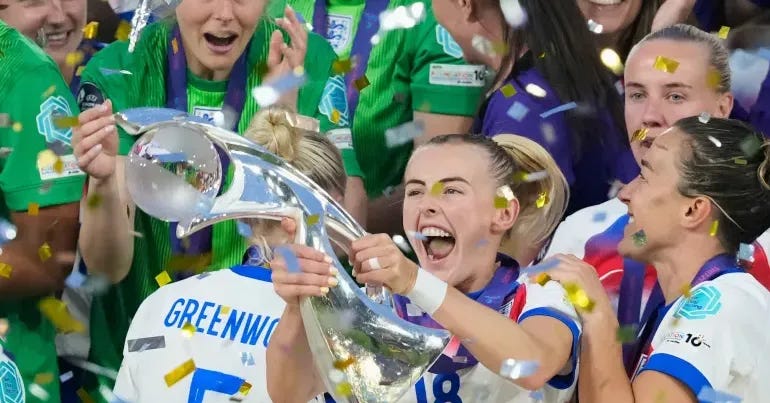
If both men’s and women’s teams wore merchandise carrying an anti-domestic violence message, it could drive awareness and capitalise on an already growing market in female football fans. The Women’s Euro 2025 semi-final on ITV drew 8 million viewers, the channel’s biggest overnight audience of the year, and its biggest among adults aged 16 to 34. Not to mention that, within the next five years, women are predicted to control 75% of global discretionary spend.
Investing in women could be the best commercial decision they have never made.
I am not saying that football causes domestic violence; the causes are structural, poverty, mental health, the breakdown of a family, but there is a clear correlation, and if FIFA, as just one example, invested in preventing it, as a moral argument and an opportunity, it could over time create the conditions for government to change those structures. To fund better housing opportunities for single parents, to fund better mental health support, to create more equal employment opportunities for women, and to build an education system designed with girls at the centre.
Because the culture that generates domestic violence is the same permission structure that often generates stadium violence, racist abuse, and anti-immigration riots. The media organisations that have spent decades creating content around women as bodies, problems, or punchlines, are part of the same architecture. A culture that thrives on a zero-sum world, where more for women means less for men.
The question we should be asking is: how does more for women mean more for everyone?
Investing in female products is not new; the global femtech market, from menopause to sexual wellness and fertility, is worth $60 billion globally, but this is a market created after the effect. My question is: how do we build a commercial architecture in which we design, create and invest with women as implicit, in the same way we do with men?
So instead of asking what we owe women, let’s ask what we gain when we stop treating us as peripheral. And that, I think, is a better question.
Next week I will be back with why I think Andy Burnham is asking the wrong questions about what our education system needs…
Well, power to that!!
Epic!